Did Medicare Really Call You? How to Spot 3 Medicare Scams
Short answer: Medicare won't call, text, or email you out of the blue to ask for your Medicare Number, bank details, or a payment, and it never calls to sell you anything. Medicare or a plan calls only in limited cases, such as a plan you already belong to, a 1-800-MEDICARE representative returning your call, or a follow-up on a fraud report you made. Three fakes to watch for are a caller saying you need a "new" Medicare card, offers of "free" braces or equipment, and "free" genetic tests in exchange for your Medicare Number. When in doubt, hang up and call 1-800-MEDICARE (1-800-633-4227) yourself.
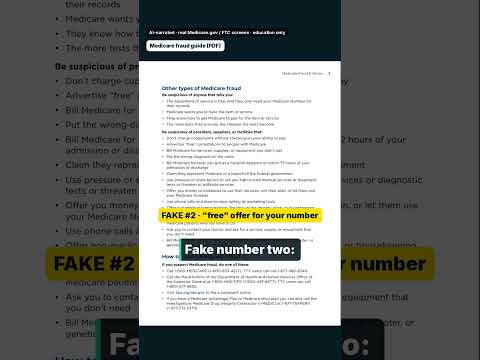 ▶ Watch the short video
- Caller ID can be faked. A call that shows "Medicare" on the screen may not be Medicare.
- If Medicare denies a claim for a genetic test your doctor didn't order, you could owe the entire cost, which could be thousands of dollars.
- Never pay anyone for a Medicare card. Real cards and replacements are free.
Step by step
- Hang up on unexpected Medicare calls. If someone calls, texts, or emails out of the blue asking for your Medicare Number, money, or bank details, stop and don't answer their questions. Caller ID can be faked, so call 1-800-MEDICARE (1-800-633-4227) yourself to check.
- Remember that Medicare cards are free. You never pay for a Medicare card. You can print or order an official copy in your secure Medicare.gov account or by calling 1-800-MEDICARE, and all of these options are free.
- Say no to equipment or tests your doctor didn't order. Only accept braces, equipment, or genetic tests ordered by a doctor you know and trust. If a kit or brace arrives that your doctor didn't order, refuse it or send it back, and write down the sender's name and the date.
- Share your Medicare Number only with people you trust. Give it to your doctors and other Medicare providers, your insurance company or plan, or programs that work with Medicare, like your SHIP. Don't share it with anyone who contacts you first unless you gave them permission ahead of time.
- Check your statements for things you didn't get. Read your Medicare Summary Notice if you have Original Medicare, or your plan's statements if you're in a Medicare plan. In your Medicare.gov account, Original Medicare claims are generally available within 24 hours after processing.
- Report anything that looks wrong. Call 1-800-MEDICARE (TTY 1-877-486-2048) to report Medicare fraud or a Medicare impersonator. You can also report fraud to the HHS Office of Inspector General at 1-800-HHS-TIPS (1-800-447-8477) or oig.hhs.gov/fraud/report-fraud, and report the scam to the FTC at ReportFraud.ftc.gov.
When Medicare or a plan can call you
Medicare.gov says Medicare will never call you to sell you anything or visit you at your home. Medicare, or your Medicare plan, calls only in limited situations. A plan you already belong to can call you, and so can the agent who helped you join. A 1-800-MEDICARE representative can call if you left a message or were told someone would call you back. And if you reported suspected fraud, someone representing Medicare may call to follow up.
Medicare plans and agents also have marketing rules. They can't call you unless you're already a member or you gave them permission to contact you. They can't come to your home uninvited to sell anything, ask for bank account or credit card numbers over the phone unless it's needed to process an enrollment request, or offer cash or gifts worth more than $15 to get you to join. They also can't sign you up over the phone unless you called them and asked to join, or you gave them permission to contact you.
The 3 fakes to watch for
The "new card" call. A caller says you need a new or updated Medicare card and asks for your Medicare Number, bank account, or credit card number, or for a fee. Real Medicare cards are free and mailed to you, and real Medicare representatives won't tell you to pay for your card. When CMS needed to replace some people's Medicare Numbers after a 2025 data incident, it told them by mail and mailed the new cards.
"Free" braces and medical equipment. Callers, or TV and radio ads, offer a back or knee brace that they say Medicare covers, if you give your Medicare Number. Braces you didn't ask for may then be shipped and billed to Medicare, often more than one, and Medicare may later deny a brace you really need. If your doctor wants you to have equipment, they'll talk with you about it at an appointment, not have someone call you unexpectedly.
"Free" genetic tests. Scammers offer cheek swabs or test kits by phone, at booths at public events and health fairs, or door to door, to get your Medicare information. The test may be billed to Medicare even though your own doctor never ordered it. If Medicare denies the claim, you could have to pay the entire cost of the test, which could be thousands of dollars.
Where to report, and what to do if you shared your number
Call 1-800-MEDICARE (1-800-633-4227, TTY 1-877-486-2048) if you see charges for things you didn't get, if you think your Medicare Number has been used fraudulently, or to report a Medicare impersonator. If you need to replace your card because you think someone else is using your number, call 1-800-MEDICARE. A replacement card is free.
For fraud involving a Medicare Advantage Plan or a Medicare drug plan, you can also call the Investigations Medicare Drug Integrity Contractor (I-MEDIC) at 1-877-7SAFERX (1-877-772-3379). The HHS Office of Inspector General takes fraud tips at 1-800-HHS-TIPS (1-800-447-8477) or online at oig.hhs.gov/fraud/report-fraud.
Report the scam to the FTC at ReportFraud.ftc.gov. If you think someone has stolen your identity, Medicare.gov points to the FTC's IdentityTheft.gov. Your local Senior Medicare Patrol (1-877-808-2468) gives free, one-on-one help to spot and report Medicare fraud.
Common questions
Is Medicare calling people about new Medicare cards?
A call saying you need a new or updated card, and asking for your Medicare Number or a fee, is a sign of a scam. Medicare won't call you uninvited to ask for personal information, and Medicare cards are free and mailed to you. When CMS has needed to replace cards, such as after a 2025 data incident, it told people by mail. If you're not sure, hang up and call 1-800-MEDICARE yourself.
Can a Medicare plan or agent call me during Open Enrollment?
Only in certain cases. A plan can call you if you're already a member or you gave it permission to contact you, and the agent who helped you join can call you. Plans can't sign you up over the phone unless you called them and asked to join, or gave them permission to contact you. You can report a plan or agent that breaks these rules to 1-800-MEDICARE.
Is a free back brace from Medicare a scam?
An unexpected call or ad offering a "free" brace in exchange for your Medicare Number is a known scam. Only accept equipment that a doctor you know and trust has ordered. If a brace you didn't ask for shows up, refuse it or send it back, write down the sender's name and the date, and report it.
What should I do if I gave my Medicare Number to a scammer?
Call 1-800-MEDICARE (1-800-633-4227) and tell them you think someone else may be using your Medicare Number. Watch your Medicare Summary Notices or plan statements for services you didn't get. If you think your identity was stolen, report it to the FTC.
How can I tell if a Medicare website is real?
Type Medicare.gov directly into your browser instead of clicking a search ad. The FTC warns that scammers pay to appear at the top of search results and use look-alike web addresses and official-looking logos. Look for the .gov ending, and scroll past results marked "Ad" or "Sponsored."
Official sources
- Reporting Medicare fraud & abuse — Medicare.gov (checked 2026-10-16)
- Your Medicare card — Medicare.gov (checked 2026-10-16)
- Medicare plan marketing rules — Medicare.gov (checked 2026-10-16)
- Medicare & You 2027 (official handbook), pages 27 and 109-110 — Medicare.gov / CMS (checked 2026-10-16)
- This Medicare Open Enrollment season, learn how to protect yourself from scams (September 30, 2025) — FTC Consumer Advice (checked 2026-10-16)
- Your Medicare number is valuable. Protect it (June 5, 2024) — FTC Consumer Advice (checked 2026-10-16)
- What to know ahead of Open Enrollment to avoid health insurance scams (September 28, 2026) — FTC Consumer Advice (checked 2026-10-16)
- Fraud Alert: Genetic Testing Scam — HHS Office of Inspector General (checked 2026-10-16)
- Fraud Alert: Nationwide Brace Scam — HHS Office of Inspector General (checked 2026-10-16)
- Report Fraud (OIG Hotline) — HHS Office of Inspector General (checked 2026-10-16)
- CMS Notifies Individuals Potentially Impacted by Data Incident (June 30, 2025) — CMS (checked 2026-10-16)
- June 1-5 is Medicare Fraud Prevention Week (June 2, 2026) — CMS (checked 2026-10-16)
- ReportFraud.ftc.gov — FTC (checked 2026-10-16)